Landowner Withdrawal from a Flat-for-Land Construction Agreement: Retroactive or Prospective Termination?
A 2025 Turkish Court of Cassation ruling clarifies whether landowners can rescind flat-for-land construction contracts retroactively or only going forward.

A decision rendered on 16 May 2025 by the Grand General Assembly for the Unification of Case Law of the Turkish Court of Cassation (Yargıtay) has reopened a question that has lingered in flat-for-land construction agreements for decades: when a landowner withdraws from the contract with the contractor, does the agreement terminate retroactively or only prospectively? The distinction may look technical on paper, but it directly determines the fate of the landowner's remaining share in the title deed (TAPU), the price already paid to the contractor, and any independent units already sold to third parties.
As urban regeneration projects have accelerated in recent years, so has the number of projects left half-finished or that fail to progress in line with the contract. When a landowner wants to terminate such an agreement, two distinct legal paths are available: treating the contract as if it had never existed, or accepting everything performed up to that point and ending the relationship only for the future. The choice between the two has a direct bearing on the compensation the landowner will end up paying and the rights the landowner can reclaim from the contractor.
Rescission or Termination? The Practical Difference Behind the Conceptual Distinction
The default-in-performance provisions of the Turkish Code of Obligations governing bilateral contracts give the creditor a choice: demand performance, waive performance and claim damages, or rescind the contract. Where rescission is chosen, the contract is treated as though it had never come into existence, and the parties are obliged to return to each other whatever they have received.
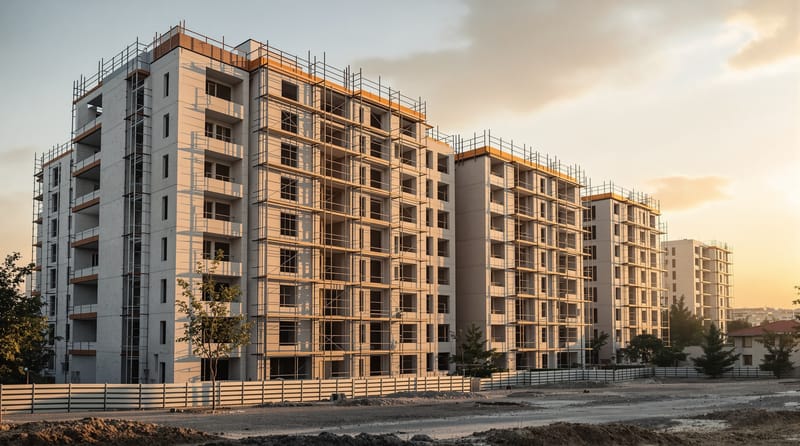
In a flat-for-land construction agreement, this means the land share transferred to the contractor reverts to the landowner, while the contractor becomes entitled to claim the value of the work carried out up to that date. Once construction has passed a certain stage, however, this restitution is no longer practically feasible. If, for example, a landowner's contract in Kadıköy involves a building whose shell construction (kaba inşaat) is already complete and three independent units have already been sold to third parties, treating the contract as though it never existed would mean disregarding both the building itself and the rights already acquired by those third parties.

The Consequences and Limits of Retroactive Rescission
Where retroactive rescission is applied, the relationship between the parties is wound up under the rules on unjust enrichment. The landowner reclaims the transferred share while the contractor may claim the value of the work performed. This solution produces a fair outcome where the contract is still at a very early stage: if construction has not yet started, or only the foundation has been laid, restitution is both practically feasible and reasonable.
The problem arises once construction has advanced further. Dismantling completed work is physically impossible and, in most cases, economically pointless. In a project where the contractor has finished the shell construction and progressed as far as the roof, treating the contract as though it never existed would expose both the contractor and third parties to uncertainty that is difficult, if not impossible, to remedy.
Why the Stage of Construction Should Be the Decisive Factor
The position argued here is that the stage of construction reached should not be treated as a secondary detail in choosing between rescission and termination, but as the decisive criterion itself. Where performance has not yet begun, or the part already performed provides the landowner with no benefit whatsoever, retroactive rescission remains a workable solution. Once construction has passed a certain threshold, however, it is more appropriate for the court to terminate the contract prospectively and settle accounts on the basis of the situation as it stands at that point.
The opposite approach, treating retroactive rescission as the only available remedy in every case, ends up harming both the landowner and the contractor in practice. If, for instance, a landowner in a project in Ümraniye rescinds the contract on the sole ground of delay after most of the construction has already been completed, the legal result would be that a nearly finished building is deemed never to have existed. That outcome serves neither the landowner's interests nor those of third parties.

What the Unification of Case Law Decision Changed
The decision of the Grand General Assembly for the Unification of Case Law, dated 16 May 2025 and numbered E.2024/1, K.2025/2, sets out an important framework on precisely this point. It holds that where the contractor has sold the share or independent units transferred to it in the title deed register, or has mortgaged them, to third parties, the rights acquired in good faith by those third parties in reliance on the title deed register must be protected even if the contract is subsequently rescinded with retroactive effect.
In practice, this approach limits the full reset that rescission theoretically entails. Once third-party rights are protected, the landowner's declaration of rescission does not, in effect, undo every consequence retroactively. Even where the legal characterisation remains "rescission", its consequences end up being managed in a partly prospective manner, depending on how far construction had progressed.
Practical Takeaways for Landowners: What to Do
A landowner considering terminating a contract with a contractor should first have the actual progress of construction clearly established. The completion ratio, determined through an expert (bilirkişi) examination, is the single most important indicator of whether rescission or prospective termination should be sought, and how the court is likely to treat that request.
The second step is to check the title deed records to see whether the shares or independent units transferred to the contractor have been sold to third parties, or are encumbered with a mortgage. Where third-party rights exist, the landowner's claim will most likely not be satisfied by a simple declaration of rescission alone; those rights will also need to be taken into account in the settlement process.
Finally, it is important for the landowner to clearly state the legal basis on which the termination declaration rests. A vague or inconsistent declaration can prolong the process and weaken any claim for compensation.
In short, there is no one-size-fits-all approach to terminating a flat-for-land construction agreement. The points below summarise the key factors to consider at the outset of the process.
- The actual progress of construction should be clearly established through an expert (bilirkişi) examination.
- The title deed records should be checked to confirm whether the share or independent units transferred to the contractor have been sold to third parties.
- The termination declaration should clearly state whether it constitutes rescission or prospective termination.
- If third-party rights exist, the settlement process should be structured accordingly.
Legal Disclaimer
Practice area: Construction Law