The Contractor's Statutory Mortgage for Unpaid Work: Does Article 893 of the Turkish Civil Code Cover Every Construction Claim?
An overview of the contractor's statutory mortgage under TMK Article 893, its scope, the disputed boundaries, and the registration deadlines that apply.
The Turkish Civil Code (Law No. 4721), which entered into force in 2002, grants a contractor who builds on another person's land a statutory mortgage right to secure payment for the work performed. This right, however, does not cover every claim the contractor may have against the owner. The mortgage secures only the payment claim arising from the construction contract itself, and only over real estate belonging to the owner. The boundaries become contentious in areas such as flat-for-land (kat karşılığı) arrangements, sales of finished goods, and subcontractor relationships.
The Basis and Rationale of the Right
The construction creditor's mortgage rests on Article 893 of the Turkish Civil Code (TMK) and the provisions that follow it. The article allows a contractor who builds a structure or performs other works on a parcel of land to request that a mortgage be registered over that land to secure the claim against the owner. "Contractor" here refers to the party to a construction contract (eser sözleşmesi) as defined in Article 470 of the Turkish Code of Obligations.
The legislature's reasoning is straightforward. The contractor contributes labor and materials to the owner's land, and the land increases in value as a result. If payment is not made, fairness requires that the contractor be able to recover the debt from the very asset whose value increased through that contribution.
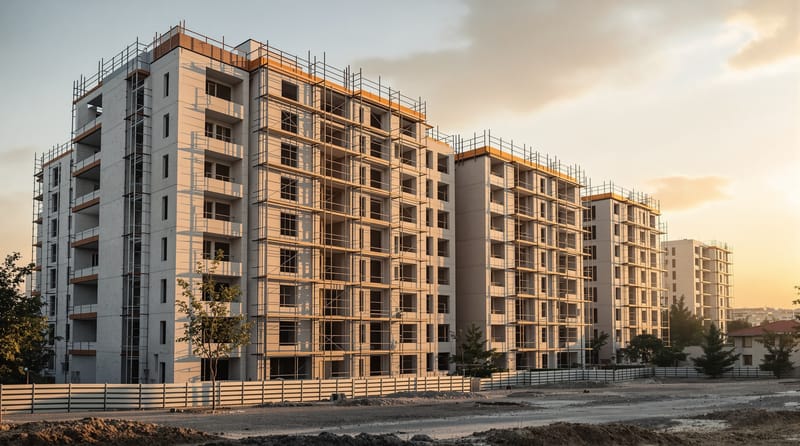
Consider an example. A landowning company in Atasehir engages a contractor on a lump-sum basis to complete the shell construction of a three-story building. The work is finished, but the last two progress payments remain unpaid. The contractor now holds a payment claim and a legal tool to attach that claim to the real estate itself.

Why Is It Disputed?
The core of the debate is which claim the mortgage actually secures. One view favors a broad reading of the statute, bringing every claim connected to the construction within its scope. The opposing view holds that the mortgage is an exceptional form of security and should therefore be read narrowly. This article leans toward the second view, since a statutory mortgage directly limits the owner's property rights, and the scope of that limitation should be drawn by the wording and purpose of the statute.
The practical consequence of this approach is as follows. The mortgage may be sought for the price owed under the construction contract. Other claims the contractor may have against the owner, such as a running-account balance arising from a separate debt relationship or an informal loan outside the contract, are not protected by the same security.
Three Areas Where the Boundary Is Tested
In practice, the applicability of the mortgage is most often questioned in three situations.
- Flat-for-land construction contracts (kat karşılığı inşaat sözleşmesi). When the contractor's compensation is not cash but a share of the land or specific units, it becomes debatable whether what exists is a "construction price" claim or an obligation to transfer title. Because these contracts are of a mixed, hybrid nature, the question resists a one-line answer. For the termination and rescission dimension of such contracts, see our article on termination of flat-for-land construction contracts.
- Sale of finished goods or materials. If the contractor merely supplies materials without providing labor, the relationship looks more like a sale than a construction contract. In that case the construction creditor's mortgage may not apply at all.
- Subcontractors and tradespeople. The legislature granted the construction creditor's mortgage not only to the main contractor who contracts directly with the owner, but expressly also to subcontractors and tradespeople who add labor or materials to the property and thereby increase its value (TMK Art. 893/1(3)). Under the Turkish Court of Cassation's settled case law, a subcontractor's statutory mortgage right is entirely independent of, and separate from, the main contractor's right. Even where no direct contractual relationship exists between the subcontractor and the property owner, the owner is statutorily obligated to grant the subcontractor a mortgage. Consequently, even though the main contractor remains the actual debtor of the claim, the request for mortgage registration, and any registration lawsuit, must be directed against the property owner. A registration claim brought against anyone other than the owner, such as the main contractor, will be dismissed for lack of standing. This right provides an exceptional and highly effective statutory protection for the subcontractor, independent of whether the owner has already paid the main contractor in full.

Registration and Timing
The mortgage does not come into existence until it is recorded in the land registry (title deed / TAPU). If the owner does not consent, the contractor's only route is to obtain a registration order from the court. The law sets a 3-month preclusive period for the registration request, running from completion of the contracted work (TMK Art. 895/2). Registration, however, requires either that the owner has acknowledged the claim or that it has been established by a final court judgment (TMK Art. 895/3). In contested cases, it is critical to request a provisional registration notation from the court under TMK Article 1011 so as not to miss the 3-month deadline.
A common mistake arises here. The contractor delays the registration step while payment negotiations with the owner continue. While the talks drag on, the preclusive period keeps running, and the possibility of registering the mortgage quietly disappears.
The law also allows the owner to block registration of the mortgage by providing adequate security. Whether the security offered is sufficient is assessed on the facts of each case.
Practical Takeaways
For a contractor considering whether to pursue the mortgage right, the sensible order of steps is generally as follows.
- Confirm whether the claim is genuinely a payment claim arising from a construction contract. What matters is the actual balance of performance, not the label given to the contract.
- Verify from the land registry that the property is indeed owned by the party who commissioned the work.
- Calendar the statutory 3-month preclusive period from the date the work was completed; ongoing payment negotiations do not pause this clock.
- If the owner withholds consent, apply to the court for registration.
- Consider other avenues for collecting the debt, such as enforcement proceedings, independently of the mortgage route.
In short, Article 893 of the Turkish Civil Code is not a general security covering every construction-related claim. The relevant boundary is the link between the price owed for the work and real estate belonging to the party who commissioned it. Where that link can be established, the mortgage is a powerful tool. Where it cannot, the claim must be protected through other legal means.
Disclaimer. These blog posts are provided for general informational purposes only, do not constitute legal advice, and do not create an attorney-client relationship. You should consult a lawyer regarding your specific legal situation.
Last updated: September 2026
Practice area: Construction Law